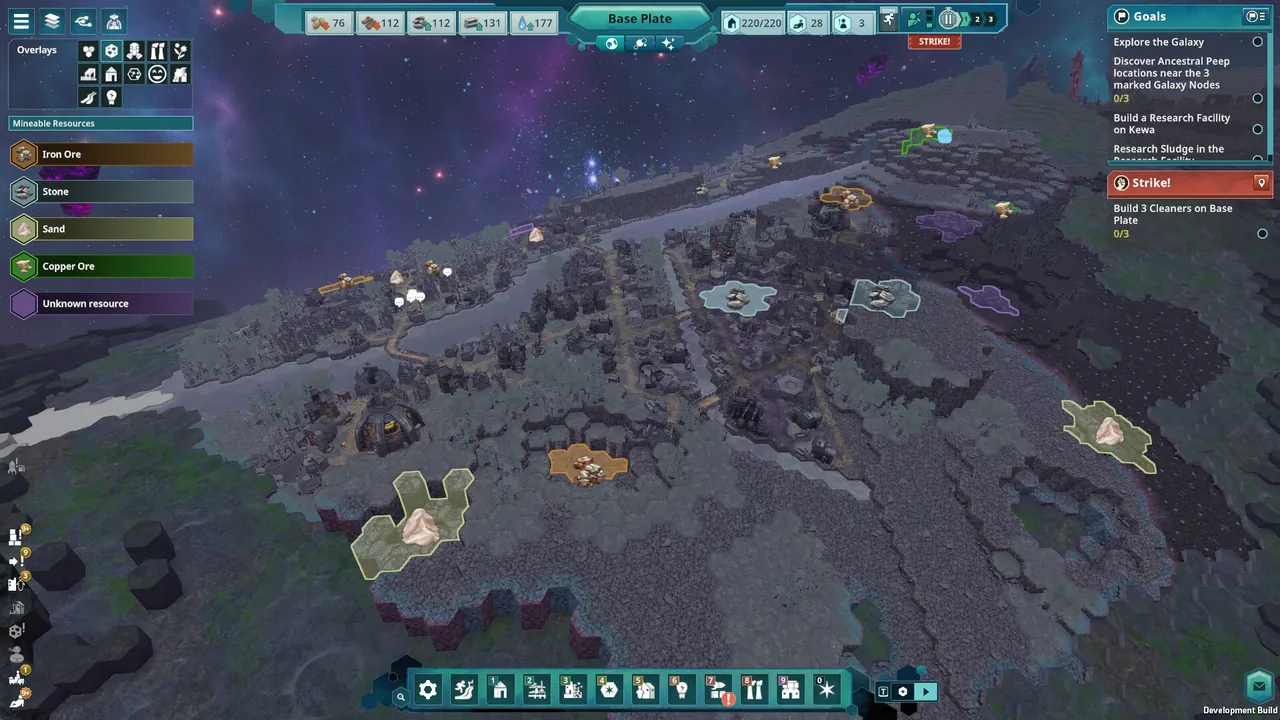
Kewa is the space whale your colony rides on — a sentient companion, and the reason the Peeps are in space at all. The official wiki records how they got here: their settlement built a Whale Charmer, arranged a rendezvous with the whale that answered, and landed. Ever since, the relationship has been symbiotic: the Peeps depend on Kewa for safety, water and fertile ground, while their work improves the biome on its back. That makes the whale's health a resource you spend without meaning to. Pollute the ground, park in a hot system too long, or answer its conversations carelessly, and the whale sickens. Treat it well and the opposite compounds: faster travel, richer memories and free buffs for your peeps. This page covers what moves Kewa's health and happiness, and what neglect costs you.
What Raises Kewa's Health and Happiness
Three inputs drive Kewa's mood, and every one of them is something you already manage on the surface.
The first is biome health. Plant trees, keep pollution off the ground Kewa carries, and run rivers around your settlements instead of through them. The developers list each of these as a direct input to Kewa's happiness, so landscaping doubles as whale care. Forest upkeep pays twice, because the same trees that lift the whale's mood supply your sawmills — see the resources guide for how that wood flows into production. Pollution is the inverse of the same dial, and the pollution guide covers how to scrub ground before it drags the biome down.
The second is temperature. Kewa dislikes long stays in hot systems. A quick stop costs little; idling there while you finish a build does not. Watch the happiness meter drift down and move the whale before it empties, because the meter is easier to top up than to refill. Cooling off means leaving for a different system, so heat is really a routing decision: keep hot stops short and treat them as errands rather than work sites.
The third is dialogue. Research eventually translates Kewa's song, and conversations then open with choices attached. Positive options build affinity and unlock more memories, while dismissive ones erode the relationship. Because health feeds happiness, these three inputs reinforce each other: a healthy whale has more to remember, and more memories mean more chances to keep it content. Planning research order around that payoff makes the technology tree more than an afterthought.
The relationship is cumulative rather than transactional. A string of small, kind choices adds up to a companion that trusts you, while a run of indifference leaves a whale that keeps its past to itself. That is why the dialogue meter is worth watching on the turns when nothing seems to be at stake.
Reading Kewa's Signals
Kewa reports its condition through the ground and its own behaviour rather than a single pop-up. Learn the signals early and you can act on a dip before it becomes a spiral.
| Signal | What it means | What to do |
|---|---|---|
| Healthy biome | Kewa is content; star travel speeds up and memory conversations open | Keep trees planted, pollution low and rivers near settlements |
| Long stay in a hot system | Happiness drains the longer the whale sits there | Finish the build and leave for a cooler node |
| Very happy | Kewa fruit trees appear around the colony | Leave them standing so nearby peeps keep the buff |
| Unhealthy | Thorny stems sprout and pass penalties to peeps | Clean the ground, cut pollution and feed the biome back |
| Low stamina | Kewa detours to a debris field to eat | Repair any buildings the stirred debris damages |
| Collapsing happiness | Emergency travel to a cold region | Treat the jump as a warning, not a cure |
Some of these are slow-burn readings and some are sudden. The biome signal shifts over many shifts, so you have time to plant and clean. Temperature moves faster, and stamina is the most abrupt of the set because a tired whale decides for itself when to eat. The emergency jump is the one to avoid entirely, since it overrides your travel plan and takes the colony somewhere you did not pick. None of these signals announce themselves loudly, so the practical habit is to check the ground beneath the colony and the mood of the whale on the same sweep, rather than waiting for a warning that may arrive too late.
Consequences, Stamina and the Story
A healthy Kewa travels faster and remembers more. That pairing is why whale care earns its keep: speed is convenience, but memory is content. Higher health opens more conversations about Kewa's past, and those conversations are how you learn who the whale is and shape what it becomes.
Memory is the payoff that is easiest to overlook, because it arrives as story rather than as a number. Every conversation you unlock adds a piece of Kewa's history, and those pieces decide how much of the whale's personality you get to see by the end of a run.
Push the mood high enough and Kewa fruit trees appear near the colony, handing nearby peeps a happiness buff. Let it fall and thorny stems grow instead, applying negative effects to whoever passes. The two outcomes sit at opposite ends of one meter, which makes the whale's condition a direct modifier on your settlement rather than a backdrop.
Stamina is a separate clock running alongside happiness. When Kewa tires, it detours to a debris field to feed, and the debris it disturbs can damage buildings, so plan repairs around a feeding stop rather than during one. A detour is not a failure state, but it is a bill. Keeping travel short and stops cool reduces how often the bill arrives, and the planets and outposts guide covers choosing destinations that suit the whale.
None of this is cosmetic. The developers state that Kewa's health shapes the story's progression and its ending, so a neglected whale is a narrative problem as much as a mechanical one. Keep the biome clean, keep the stops short and answer the whale kindly; the payout is a faster journey, a deeper companion and more of its past recovered.
Pro tip: Read the happiness meter as a build-order problem. When Kewa's mood dips, the fix is almost always on the ground beneath the colony — more trees, less waste or a cooler destination — and acting on the first dip is far cheaper than recovering from an emergency jump.
For landscape work that supports biome health, follow the terraforming guide. Before settling a new world, check the ships and landing pads guide for the first-landing exception and departure requirement.
Sources
- Official Hooded Horse wiki, Kewa (origin, symbiosis, travel): https://wiki.hoodedhorse.com/Beyond_These_Stars/Kewa
- Official Hooded Horse wiki, The galaxy (energy, debris fields): https://wiki.hoodedhorse.com/Beyond_These_Stars/The_galaxy
- Steam announcement, "Dev Blog #29 Keeping Kewa Happy": https://store.steampowered.com/news/app/2295060/view/1840944183775191
- Steam announcement, "Dev Blog #28 Settleable Planets": https://store.steampowered.com/news/app/2295060/view/1838407329267634
- Steam store page: https://store.steampowered.com/app/2295060/